About Commercial Roofers Jersey City
A commercial roofing contractor for Jersey City and nearby Hudson County and Essex County communities: inspections, repairs, coatings, maintenance and full roof replacement for occupied buildings.

A commercial roofing contractor for Jersey City and nearby Hudson County and Essex County communities: inspections, repairs, coatings, maintenance and full roof replacement for occupied buildings.
Rain on a Jersey City, NJ roof is a sequencing problem before it is anything else. Commercial Roofers Jersey City works in a fixed order: find where water enters, settle how a crew reaches that roof zone, then fit the work window around the people and operations below. The city describes itself as a dense urban, coastal community vulnerable to climate impacts, and it reports severe flooding and property damage from Hurricanes Irene and Sandy. Those facts shape how we plan a visit. They do not describe any one building, so each visit starts with the roof in front of us and the question the owner has to answer.
The first call usually begins at an interior mark: a stained tile, a damp wall, a puddle by a loading door. We start there and walk upward. A commercial roof inspection divides the roof into zones and records seams, laps, drains, curbs, penetrations, wall transitions and edge metal in each one. Every finding gets a photograph and a location, and the report keeps what we saw apart from what we suspect.
Where a stain and a roof defect do not line up, water has usually traveled along a deck flute, an insulation joint or a pipe. We say so, mark the likely route, and name the test that would settle it. An infrared moisture survey narrows the wet area when conditions allow, and a test cut confirms the layers at one chosen point. The owner then decides on evidence: repair the opening, monitor the zone, or budget a larger scope.
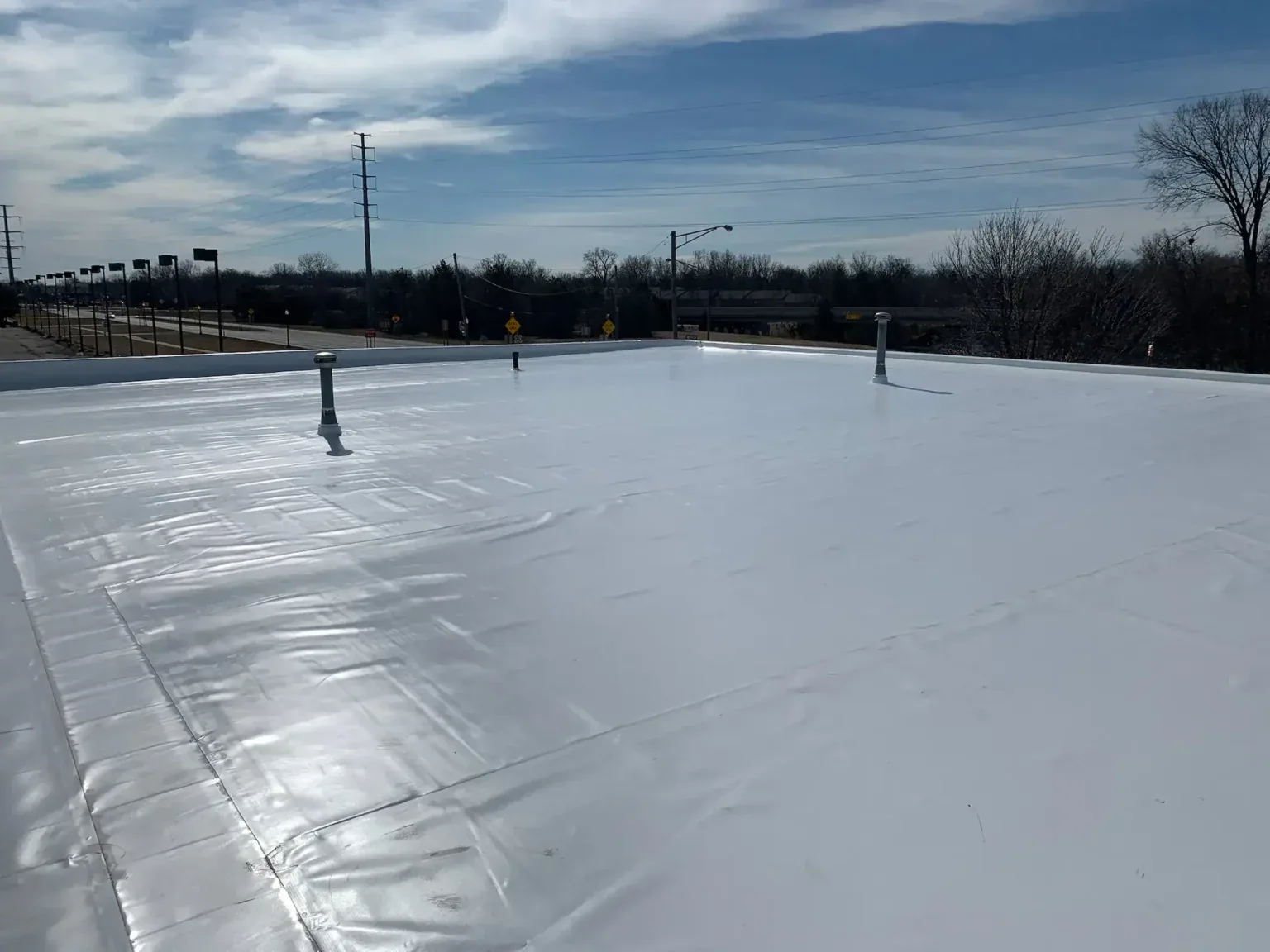
A roof job fails or holds at the end of the shift. We open only the area the crew can dry in before leaving, and each day closes with a sealed tie-in, a photograph and a written note of what is protected and what is next. Weather sets the pace. Welded seams need a dry sheet, adhesives and coatings have temperature limits, and a forecast change shrinks the open zone instead of stretching the crew.
The same order governs people. Before mobilizing we confirm the lift plan, the staging area, the hatch or stair route, the tenant hours and the equipment that cannot be shut down. On an occupied building those answers decide the zone size and the start time, and they are written into the plan the site contact approves. Emergency calls run around the clock, holidays included, and the first visit stabilizes the opening and records what remains for the permanent repair.
Send the property address, the roof type if you know it, and what you are seeing inside the building. We reply with the next practical step.
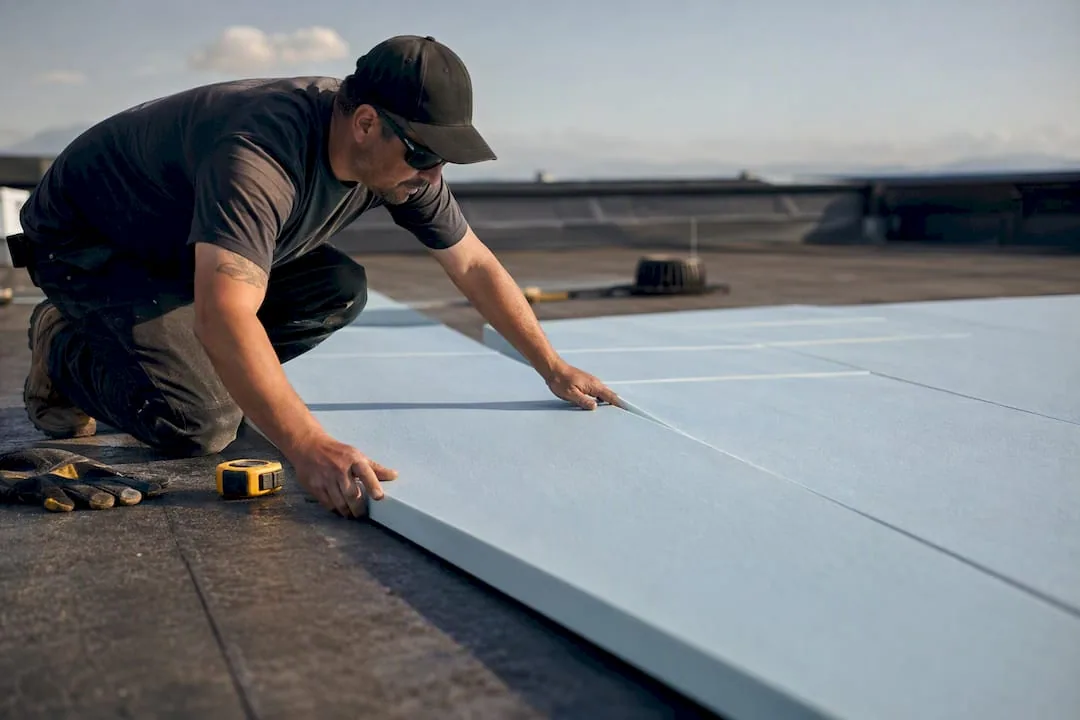
Jersey City lists localized flooding and combined-sewer stormwater loading among its concerns, and its planning resources include a Stormwater Control Ordinance and a Flood Overlay Map. A roof cannot fix a street. It can keep its own water moving, so we trace each slope to its outlet and check strainers, bowls, clamping rings, scuppers and overflow routes before judging the membrane around them.
Standing water tells us where to look. A ponding-water repair starts with the outlet and the slope, then moves to seams and flashing at the edge of the pond. A blocked bowl is a maintenance entry, a split drain flashing is a repair, and a low area that never drains is a design question. The report keeps those three apart so the right budget line pays for each.
We repair and maintain TPO, PVC, EPDM, KEE, modified bitumen, built-up and standing-seam metal roofs, along with spray foam and silicone or acrylic coating systems. The label on an old proposal does not settle compatibility. We identify the installed system from exposed edges, seams and available records, because a heat-welded patch will not bond to a rubber sheet and a coating will not cure over wet insulation. A TPO roof and an EPDM roof ask for different seam checks.
The decision sequence is short. If the defect is local and the field around it is dry and bonded, a commercial roof repair closes it. If the surface is sound but worn, coating restoration may fit after repairs. If moisture has spread or layers cannot be secured, recover and replacement are compared on the same roof map, with drain height, edge metal and access priced.
Jersey City packs 19,835.1 people into each of its 14.74 square miles, according to the 2020 Census figures. On a roof job that density becomes curb space, shared walls, a single stair and a lift that needs a lane. The City Master Plan sorts the city into six wards, starting with Greenville and West Side/Marion and running through Journal Square, The Heights, Downtown and Bergen-Lafayette. Commercial centers in those materials include the Route 440/Culver area, West Side Avenue, Central Avenue and Journal Square, and three industrial planning areas appear beside them: Greenville, Tonnele Avenue and Chapel Avenue.
The same plan says the city's building stock changed substantially after 2000, with investment reaching Newport, Downtown and Journal Square first and other neighborhoods later. A district name still tells us nothing about a roof. A Downtown repair does not describe a Greenville building, so each address gets its own roof map, access contact and staging plan.
Every visit ends with a file a stranger can read: zone map, dated photographs, materials, open items and the person who owns the next decision. A roof condition report carries that file between managers and across a sale. For several buildings, roof asset management keeps the zone labels consistent so one building can be ranked against another by observed condition.
Budgets follow the same record. Roof capital planning turns the findings into an action year for each roof, with the trigger that would move it earlier or later. The owner sees which repair buys time and which one only postpones a larger project.
We take roof calls in Jersey City and in Hoboken, Bayonne, Union City, Newark, Kearny and Elizabeth. Hoboken, Bayonne, Union City and Kearny sit in Hudson County, Newark in Essex County and Elizabeth in Union County. Each town has its own streets, access rules and permit contacts, so a Bayonne visit gets a fresh route plan instead of a copy of a Jersey City one.
To set a visit, send the address, the roof access contact, the leak history and the hours the building cannot give up. We walk the roof, mark the priority zones and return a written scope with the work windows it needs.